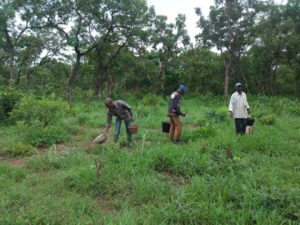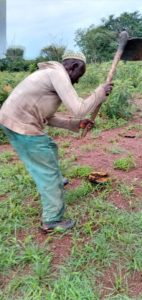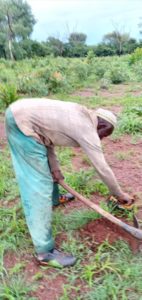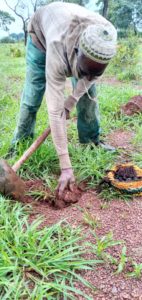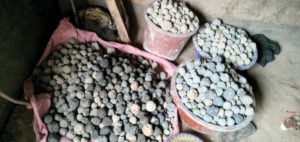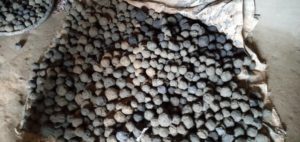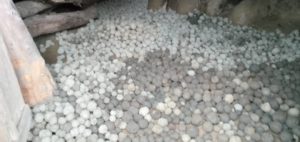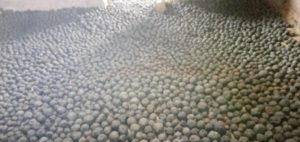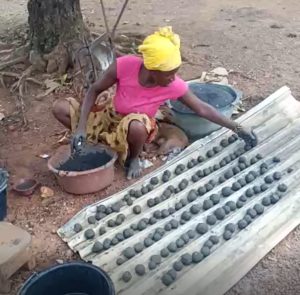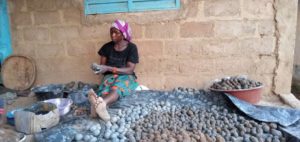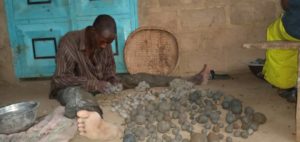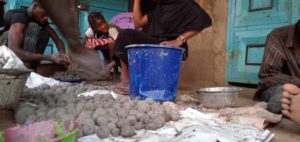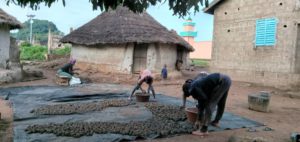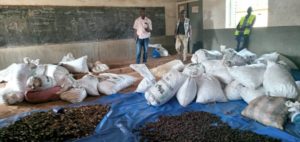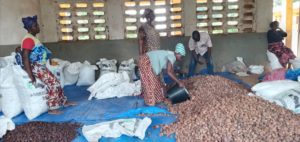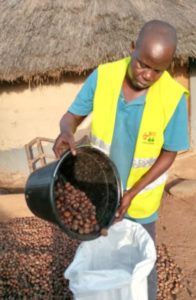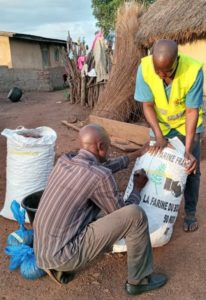
The seed bombs are put to dry. There are seedballs in every corner of the village!


Why put them to dry under cover and not in the sun? Because the rainy season has started in Linko, which is good news for the seeds!
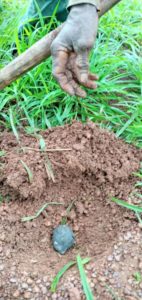
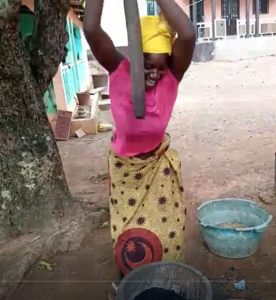
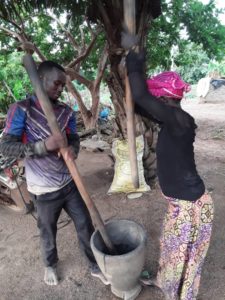
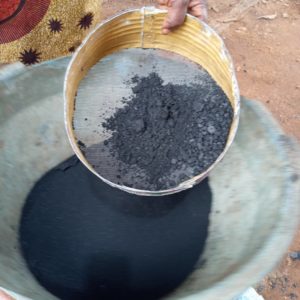
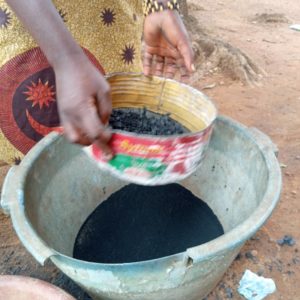
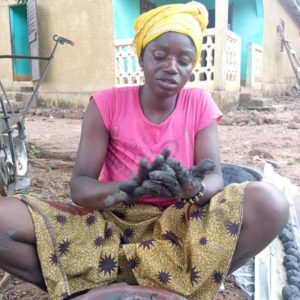
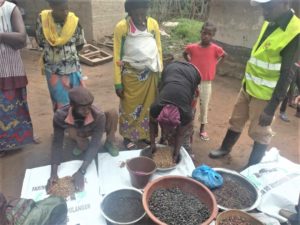
Back in the villages, the seeds are coated to make the famous seedballs. It’s very simple, you just have to mix clay powder with charcoal powder and a little water. Of course, the clay and charcoal must first be crushed to make a powder which is then sieved.


The result is a sticky paste into which a seed is inserted. Then you roll it between your hands to make a ball.


And then you let it dry in the sun.


It’s amazing, you can find seedballs coaters in every corner of the village!


Is the dosage secret? Not at all! It is an important principle of arboRise to experiment and share our experience, our successes and failures. The recipe is here, try it!
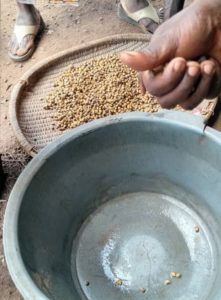
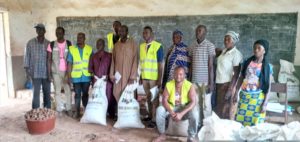
In order to strengthen biodiversity, we are making a large mixture of all the seeds of all the tree species. This happens in Linko, the capital of the sub-prefecture. The 10,000 seeds collected by each of the 75 families are collected in a free classroom, made available by the mayor of Linko.


Several women growers come to help our team.


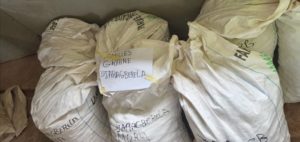
Finally the seed mixture is put back into the bags for pelleting. The destination of each bag is noted so that no village is forgotten.


This stage is crowned by the official thanks of the Sub-Prefect and a photo of all those involved.


The biodiversity of tree species will make the forest more resilient to the dangers that threaten it (parasites, fires, livestock, etc.).
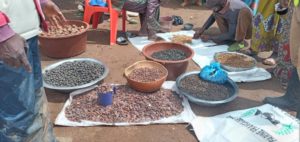
Under the eye of the village children, the women farmers bring in their harvest of seeds.


The seeds are counted and weighed,


and then put into bags for transport to Linko, the capital of the sub-prefecture.


arboRise’s principle is to fully involve the population concerned by the project. This way, they take ownership of the forest, their forest. In addition, the project creates enthusiasm, a collective energy in each village. This mobilisation is an important lever for change and a source of hope for the entire region.
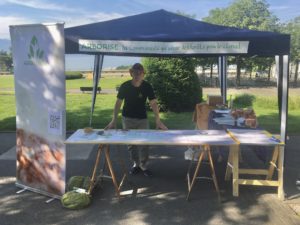
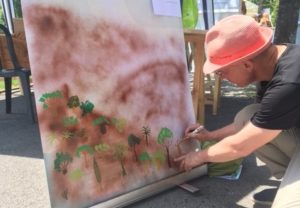
Amazing how many positive and inspiring encounters we had at our stand at the Objectif Terre Festival! Thank you to all members who visited us and to all people who discovered us on this occasion. Your compliments and wishes for success give us a lot of energy.

Like the biodiversity of the trees which we plant in Guinea, the trees which have been drawn on our collective fresco show the diversity of our visitors:


What is most appealing about arboRise ? Our participatory approach and our natural organic reforestation methods.
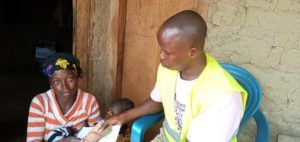
Upon delivery of the seeds by a family, our team performs a quality control. Our partner also checks the quantity delivered. After all, it takes 10,000 seeds from each of the 75 seed trees!


The family that collected the seeds is then paid and thanked for their work.


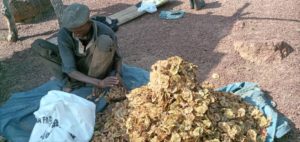
Then the seeds are put into the big bags. Soon they will be transported to Linko to mix all the species.


Each bag is duly identified: we will soon be talking about protected designation of origin AOC for Guinean seeds!


The 75 “seed families” who are involved with arboRise have started collecting seeds from their trees. With 10’000 seeds per family, this work takes time! Depending on the type of seed, the transport can even be heavy. Of course, as soon as the seeds are delivered to our team, the work is paid for at its fair value.
After having dealt only with men until now, our team is now working with the women farmers, as they are traditionally responsible for the harvest.
In each village, our team also explains that our drone will be used to check the growth of trees on the land. Indeed, to guarantee our donors the traceability of their donation, arboRise commits to send them for five years an aerial image of the land which reforestation they financed.
There are only five helicopters in the whole of Guinea and it is very rare that they fly over this region. So imagine a drone: nobody has ever heard of it! So it is important to introduce this mysterious object. And only after receiving official approval from the village authorities will we use it.
Our team is back in the field to finalise the reforestation campaign. Let’s remember that they have concluded agreements with 75 local farming families who wish to restore 2 hectares of land by planting a forest. Now they need to find the seeds to sow !
So lokk for 75 families who own one of our 40 native seed trees. Of course, we have to check that the tree is healthy and old enough to produce seeds. Each “seed family” collects 5,000 seeds from its seed tree. The 750,000 seeds to sow from the 75 “seed families” will be sown on the 150 hectares of the 75 “field families”. This gives a density of 5,000 seeds per hectare.
This diversity is the strength of arboRise:
Here is Mr Siaka Camara posing in front of his seed tree:


The arboRise approach values the seed trees of these families. Since they suddenly “produce” money, there is less temptation to cut these trees down.
Saturday 22 May is Biodiversity Day ! At arboRise we love diversified forests.
But why is this important? It’s quite simple: life is only possible because it is diverse.
On the one hand, there are the basic interactions: every life form is food or shelter for another living being.
On the other hand, there are all the complementary associations that reinforce each other. An example: the Three Sisters culture of the American Indians. By planting maize, beans and squash together, the Three Sisters method increases the yield of each crop, while improving the soil:
Each plant benefits from the services of the other two. In economics this is called “economies of scope“, when making two different products is cheaper than making them separately. There are many examples of how “economies of scope” can be used, especially in agriculture. Planting walnut trees alongside a barley field increases the productivity of the field because the roots of the trees bring water up from the subsoil and the branches protect the soil from erosion. And the nuts produce oil and the walnut wood is prized for carpentry. This is agroforestry, one of the solutions for the ecological transition of our agriculture.
Unfortunately, most of the time, our society prefers “economies of scale” which consist in ditributing fixed costs over as many units of the same product as possible. Unfortunately, this standardisation creates fragile monocultures, which then require pesticides or herbicides.
Focusing on biodiversity and economies of scope is the principle adopted by arboRise: instead of seeking economies of scale by focusing on one or two species, raised in nurseries, and planting monocultures, we prefer to maximise the diversity of tree species to favour eco-system services and thus obtain the lowest reforestation costs.
Supporting arboRise means planting a diversified forest and therefore also doing something for biodiversity, one of the United Nations’ sustainable development goals