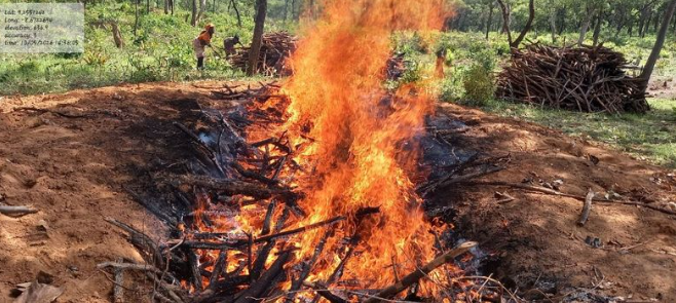
What is biochar and why is it important? In Guinea, due to the low fertility of tropical soils, farmers face low yields and are forced to practise extensive farming over large areas. This is why they practise shifting cultivation (slash-and-burn). After being cultivated for around five years, the land loses its fertility and must be left fallow for about ten years to regenerate. When the farmer sees that the land is fertile again, he burns the vegetation (shrubs, young trees) that has grown up on the old fallow land. The ashes are mixed into the soil during ploughing, before sowing (usually with upland rice), provided they have not been washed away by the rain beforehand.
Why are tropical soils not very fertile? They have a low organic carbon content, as decomposition proceeds very rapidly under hot and humid conditions. This limits the soil’s ability to store nutrients. Furthermore, tropical soils are heavily leached due to heavy rainfall. This leads to the loss of soluble nutrients such as nitrogen, calcium, potassium and magnesium. Many tropical soils are acidic, which reduces the availability of certain nutrients to plants.
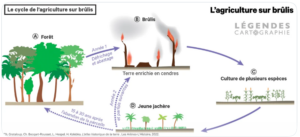
This process generates significant CO₂ emissions. The practice of slash-and-burn farming (‘shifting agriculture’) is the main cause of deforestation (loss of biodiversity) and CO₂ emissions in Guinea (Report on the preliminary estimate of greenhouse gas (GHG) emissions and removals from the forestry sector in Guinea, World Bank 2024) and indeed across Africa as a whole:
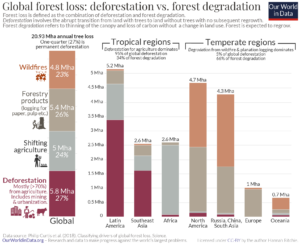
The farming families taking part in the arboRise project are therefore among the 130 million farmers who have to resort to slash-and-burn farming to compensate for the poor quality of their soil. The first three minutes of this Video show a fallow field being cleared and then burnt in the region where our project is based. Until now, the advice from ‘developed countries’ has been: buy our fertilisers! (and our pesticides! and our herbicides! and our tractors! and our improved seeds! etc.)
But what if there were a more sustainable and less expensive alternative?
Let’s take a brief detour to the Amazon, where archaeologists have discovered, in many places, a black and extremely fertile soil that the locals call ‘terra preta’. It seems that pre-Columbian peoples, who also practised slash-and-burn agriculture, enriched the naturally poor soil with organic matter and, above all, charcoal – or, more precisely, biochar.
Biochar is what remains after the pyrolysis of biomass (pyrolysis: the decomposition of organic matter at high temperatures in the absence of oxygen). It resembles charcoal, but is much more porous. Thanks to its high porosity, biochar is an excellent fertiliser: it absorbs water and harbours microorganisms and mycorrhizae that are beneficial to plants. We also recall (see the latest edition of this newsletter) that biochar reduces soil acidity.
Normally, it is produced in kilns called Kontiki, invented and tested by the Ithaka Institute, a Swiss NGO that is a pioneer in this field. The principle is very simple: ensuring that the burning biomass is always covered by a curtain of flames to prevent oxygen from the air from entering the kiln and combining with carbon to form CO₂.
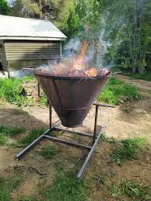
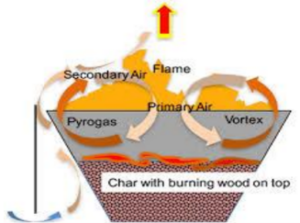
To summarise: Guinean farmers must regularly clear (= cut down trees) on their long-fallow land in order to cultivate it. At present, they burn the vegetation and use the ash as fertiliser, but this is washed away by the rain and, more importantly, this process releases a huge amount of CO₂ into the atmosphere.
What if we helped this farmer turn this wood into biochar, which could then be worked into the soil whilst ploughing? This would boost soil fertility using a natural, free substrate, whilst avoiding CO₂ emissions. Let’s dream a little: perhaps this farmer could then cultivate his field for longer and thus delay the next time he has to clear the land… Turning fallow crop residues into biochar could therefore be a way of reducing deforestation… Imagine the impact if 130 million farmers changed their practices!
We thought to ourselves: it’s worth a try.
All the more so because, as this process enables carbon to be sequestered in the soil whilst avoiding CO₂ emissions, it is possible to generate income from carbon credits. There are several carbon certification standards for biochar, generally involving the conversion of crop residues (rice straw, maize or sugarcane stalks, coffee husks, cocoa pods, etc.) into biochar. We have opted for the Global Artisan C-Sink methodology from Carbon Standard International, which is designed for small-scale biochar producers, such as our farming families. This standard sets out numerous requirements, such as:
- Ensuring the traceability of the sourced biomass: it must be ensured that the producer does not cut down trees indiscriminately, but that their biomass comes from fallow land which they had in any case intended to clear.
- The fallow land must not be more than 10 years old (no old trees)
- The pyrolysis process must comply with quality standards to minimise CO₂ and methane emissions and achieve a high carbon content: the wood must be completely dry; combustion must not emit smoke or produce ash, and must reach a temperature of 700°–800°
- The fire must go out very quickly
- The volume of biochar produced must be measured accurately
- The ratio of volume to dry weight must be measured in a laboratory
- The project must demonstrate that all the biochar has been incorporated into the soil
- The carbon content of the biochar must be measured in a laboratory
To document this, our supervisors are equipped with a specialised app, developed for us by Circonomy :
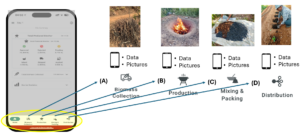
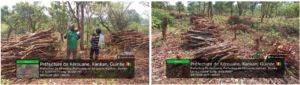
As this was a pilot scheme, we decided to limit ourselves to 50 field-families, located in four villages in the southern part of our project area, to make it easier for our supervisors to coordinate and document the work. The 50 farmers received training (both theoretical and practical); their 2 hectares of fallow land, which they wished to clear, were georeferenced; and the land ownership certificates were signed by their village council of elders (as we already do in the reforestation project). Each farmer received their equipment, cleared their fallow land as planned, laid the wood out to dry and dug their production pit.
Land clearing and wood drying:
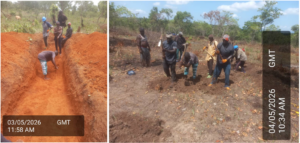
Digging pits of 14 m³ (on 2 ha of fallow land there is a great deal of wood: the Kontiki kilns would have been too small and production would have been very complicated)
At the same time, we also wanted to give a role (and an income) to the seed-families, so as to include women in this activity as well. Enriching biochar with nitrogen-rich materials further enhances its fertilising power. That is why we asked the women’s groups in the four villages to collect manure, which will be mixed with the biochar before it is incorporated into the soil.
The actual production of biochar took place under difficult conditions, mainly due to the late timing of the activities (a decision dictated by the availability of the CERES CERT auditor and the availability of the Circonomy documentation tool). Producing the biochar competed with other agricultural work, and the supervisors had to put in a great deal of effort to convince the farmers to honour the agreement they had signed. This is a valuable lesson for next year.
Another lesson is the complexity of the production process: to meet all the standard’s requirements, a great many resources need to be co-ordinated and synchronised (having enough wood to fuel the fire, having sufficient water to extinguish the pit, obtaining manure from women’s groups, arranging for oxen to plough, etc.) and perhaps we have overestimated the farmers’ management capacity. We will optimise this aspect in 2027.
Producing biochar requires the coordination of several resources: labour, wood, water, tricycles, manure, oxen, etc. Synchronising these resources is a challenge.
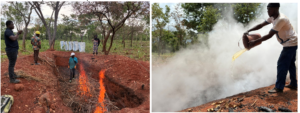
The biochar audit was intensive, as we visited 20 producers in three days so that the auditor from Burkina Faso could check all aspects of the project across a representative sample of producers. He was particularly thorough in his feedback, going into the finest details (for example: how to angle the ploughshare so that the biofertiliser can be easily incorporated and the furrow closed up on the next pass of the plough). We therefore came away with plenty of ideas for improvement for 2027.
Every auditor has their own areas of focus. For our auditor, these were the quality of the ignition, the mixing of biochar with manure, the incorporation of the biofertiliser into the soil, and the representativeness of the sampling.
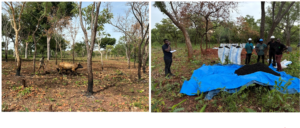
In the end, 1,445 270-litre bags were produced across 127 production ‘batches’. This represents 300 tonnes of CO₂ (bearing in mind that the average Swiss person generates 15 tonnes of CO₂ per year). This production is currently being verified, and the 300 carbon credits should be issued before the end of this year. This is another major advantage of biochar: carbon revenues are generated immediately.
The rainy season is drawing to a close, and in a few weeks’ time we will also know what effect the biochar has had on the agricultural yield of the rice sown by the farmers. One of them has already spontaneously expressed his great satisfaction with his harvest.
We would like to take this opportunity to extend our sincere thanks to REPIC, a joint initiative of SECO, the SDC, the FOEN and the SFOE to promote renewable energy, energy efficiency and resource efficiency in developing and transition countries, which placed its trust in us by funding this pilot project, impressed by our two objectives:
- To increase agricultural yields using biochar-based biofertiliser
- To utilise plant waste (fallow land residues) through carbon credits