As we recall, in 2025 the land-owning families had agreed to allocate 10 per cent of their ‘carbon income’ to their village. The amount was distributed in proportion to the number of land-owning families and the area of land reforested by each village. Thus, Forono, the largest village, received around CHF 800, whilst Kala, the smallest village, received CHF 50. As these sums were insufficient for genuine infrastructure works, they were spent without any lasting impact.
We wanted to change this and proposed that the cooperative’s committee consider the matter. The idea was to no longer distribute the annual CHF 10,000 from the ‘villages’ share’ amongst all 26 villages, but only to two villages each year. The amounts would then be sufficient to build sustainable infrastructure. The cooperative committee approved the idea and put it forward to the Cooperative’s General Assembly, suggesting that the two beneficiary villages be chosen by lot from among those that do not yet have a borehole (as access to water is the most critical piece of infrastructure for a village). The General Assembly accepted the cooperative committee’s proposal, and the villages of Mamouroudou and Diaradouni were chosen at random.
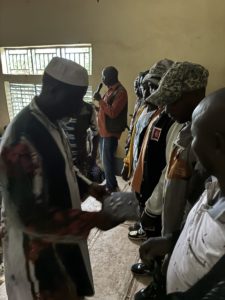
How were the two villages chosen? It’s quite simple: by drawing lots!
Next year, we will do the same in two other villages, and so on for 13 years, so that each of the 26 villages benefits from sustainable infrastructure thanks to this early form of ‘financial equalisation’.