CGC trainings follow the “train the trainer” approach. To provide immediate support to seed families and field families in each village, the project sets up a Community Management Committee. This committee is made up of 10 to 20 prominent members of the village, who are often already responsible for specific issues (women’s groups, youth, health and hygiene, etc.).
In our project, the CGCs are responsible for
- Supporting seed families and field families. The CMC coordinates collective activities (seed collection, sowing, etc.) and organizes peer learning activities.
- Identifying best practices. The CGC identifies the plots of land in its village where trees have grown best and seeks to understand why, in order to recognize best practices.
- Disseminating best practices within the village and between villages. The CGC passes on good ideas from seed families to other seed families in the village and does the same for field families. The CGC shares good examples from its village with other CGCs. The CGC is the driving force behind mutual aid.
- Training. The project trains CGCs so that they can train families in the village.
- Identifying equipment and infrastructure that is useful to the community. The CGC organizes discussions between seed families and land families to decide together what equipment and infrastructure are needed.
- The collective equipment obtained through arboRise is managed by the CGCs. The CGC establishes a plan for using the equipment according to the needs of the seed families and landowners. After use by the families, they return the equipment to the CGC, which ensures that it is in good condition and carries out maintenance.
- The CGCs coordinate health and safety measures. The CGC documents emergencies, accidents, incidents, and injuries related to the project reported by families. In case of an emergency, the CGC organizes immediate transportation to the Health Center.
- Identification of disputes or grievances related to the project. Each CGC assesses the project’s impact on the community. It can express families’ expectations of the project and advise on measures to be taken.
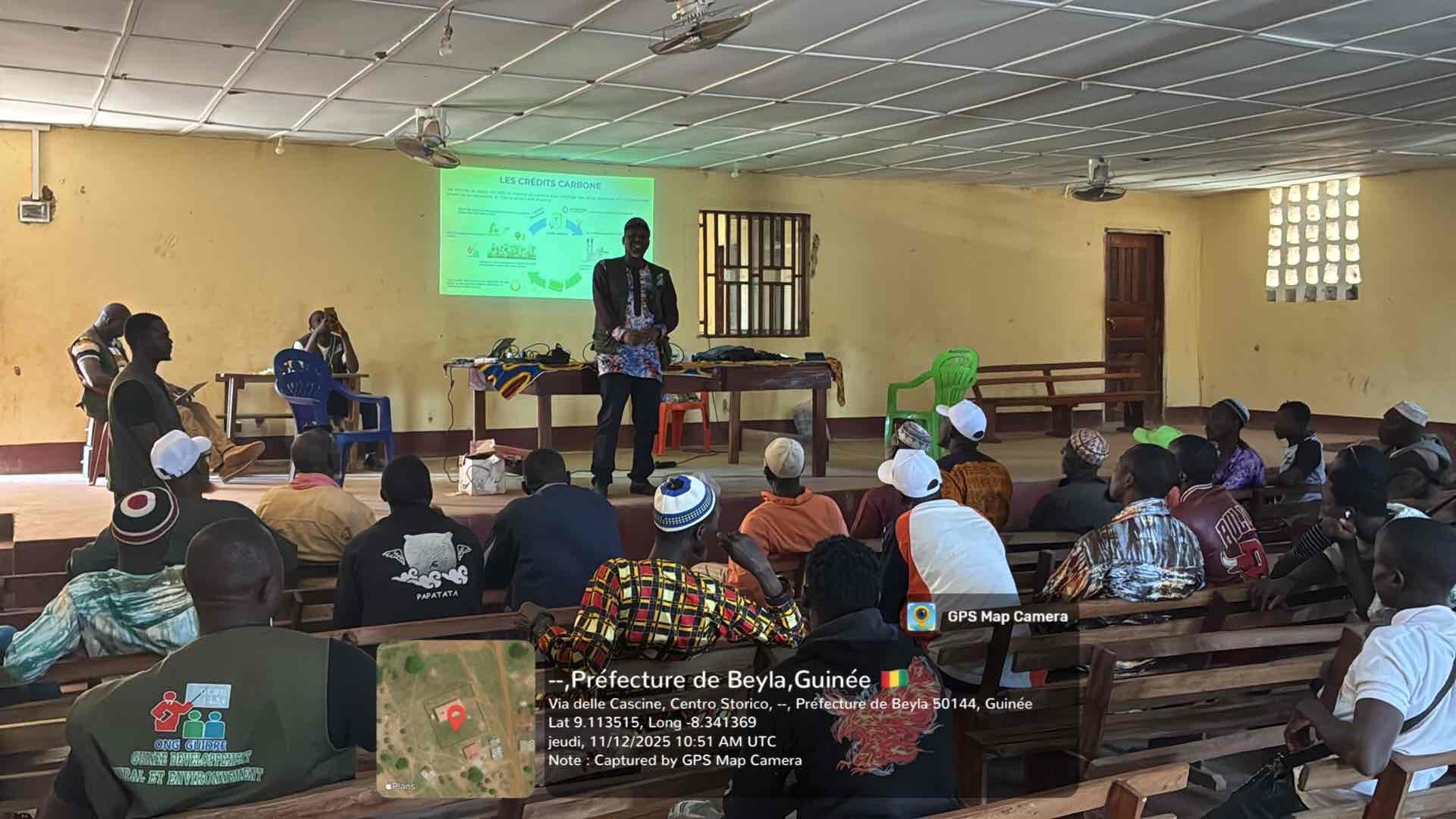
Each year, the project organizes trainings for CGC delegates from each village. In December, the CGCs from the 20 villages in Damaro received their first training covering topics such as “climate change,” “carbon markets,” “brush fire prevention,” “the roles of CGCs,” “the grievance mechanism,” etc. The CGC delegates from the villages were very attentive, and the mayor visited the participants during the training to emphasize the importance of the project for Damaro and the communities and to urge the participants to listen carefully and learn as much as possible.
These training sessions are, of course, also an opportunity to listen to and discuss the participants’ concerns. This dialogue helps to adapt the project to any specific situations that may arise.
The training took place in the new town hall, and we had the honor of receiving a visit from the Mayor of Damaro.
As in Damaro, the CGCs in Samana and Diassodou received initial training. In Samana, as we are now in the second year of the planting cycle, we explained the role of the Cooperative and analyzed the contents of the agreements in detail, as this issue had been raised by the auditors during the validation audit.
The participants were very attentive and asked some very good questions.