What is the best soil for our trees?

We have known that the soil has a significant influence on the growth of our trees since Ines and Aurèle’s Design Project 2024. We wanted to find out more as part of a new Design Project with EPFL.

Camille Perrin and Alena Vasilyeva analysed soil samples taken from 19 sites: 10 sites where our trees are growing strongly according to our dendrometric measurements, and 9 sites where our trees are not growing well.

Alena and Camille show that two groups of factors explain our trees’ growth and that pH is a key determinant. The more acidic the soil, the less accessible the nutrients present in it are to plants (paradoxically, there is more phosphorus in the soil of the underperforming plots, as this phosphorus cannot be absorbed by the trees because it is more strongly bound to other atoms).
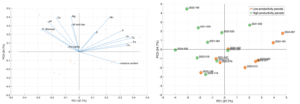
In temperate zones, liming is used to make the soil more alkaline, but lime is not readily available in our region. Ash can also be used (which is what farmers do when they burn trees to convert fallow land back into cultivated fields) or biochar (which we are going to try to introduce – we’ll talk more about that later!).

Their full report is available here: DP_Soils_final_report

Predicting land clearing

carte des défrichements

Predicting land clearing is important for our project. That is why, once again this year, we have collaborated with EPFL as part of a Design Project.

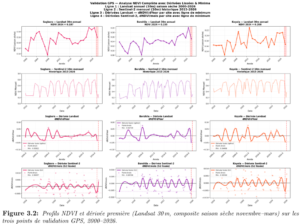
Feryel El Phil and Camille Dupré Tabti first demonstrated that the first derivative of NDVI values is a good method for identifying when land is being cleared.

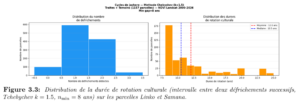
This enables them to calculate the crop rotation cycle for each plot of land. As can be seen below, this varies considerably: some plots have a rotation cycle of 7 years (roughly 2 years of cultivation, 5 years of fallow), whilst others can be as long as 25 years:

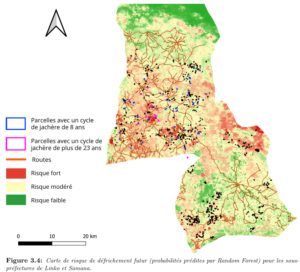
Building on these findings, they then produced a map showing the probability of land clearing in Linko and Samana and concluded that the risk of our plots being cleared increases if the land is easily accessible to farmers (close to the village) and if it is naturally fertile. We can therefore predict which land-owning families would be most likely to reconsider their participation in the project if they are not satisfied with the carbon payments they receive.

The full analysis report is available here: DP_Leakage_final_report