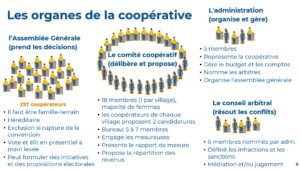

One of the Cooperative’s objectives, and the main role of the Cooperative Committee, is to develop a carbon revenue sharing formula. Indeed, it is certainly not up to arboRise to define how these revenues will be shared among the cooperative members. This choice must be made by those most directly concerned, based on local traditions and customs.
But what will these criteria be? And how should they be weighted? Should effort and merit be taken into account, or should revenues be distributed evenly? Can fate be invoked to justify certain disappointing results? Etc.
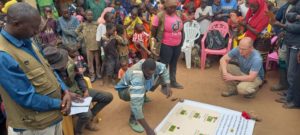
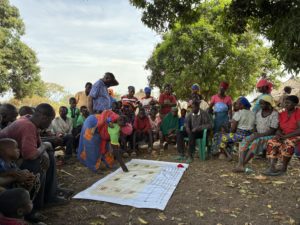
Rather than discussing these criteria in the abstract, we opted for serious games, which are more effective. In concrete terms, we used pre-printed tarpaulins showing several scenarios, such as this one, where the aim was to distribute income according to the hazards suffered by landowners:

Each member of the cooperative committee had 20 (symbolic) coins representing the project’s carbon revenues and was tasked with distributing them among the 10 situations presented on the tarpaulin, then commenting on their choice in front of their peers.
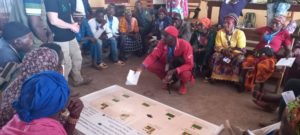

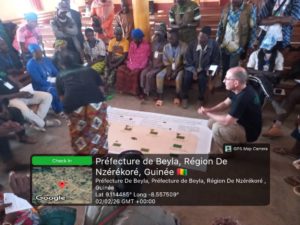
Over the course of the day, a consensus quickly emerged on the principles of carbon revenue distribution, for example:
- Compliance with the cooperative’s rules by each member must be rewarded in proportion to the effort required to comply with each rule. For example, certain ‘costly’ rules (installing firebreaks around plots) must be better remunerated than simple rules (installing barrier tape to mark plots).
- Of course, those who make a significant commitment to promoting tree growth on their land should be rewarded, but it is also necessary to give a little to those who are ‘undeserving’ because otherwise they may leave the project.
- It is necessary to (very clearly) reward the result (the density and height of the trees on the land) and not the effort that was necessary to achieve this result.
- External factors (soil infertility, fires, etc.) should not be considered inevitable: it is the responsibility of the land family if they have chosen unsuitable land or if their land has been affected by fires.
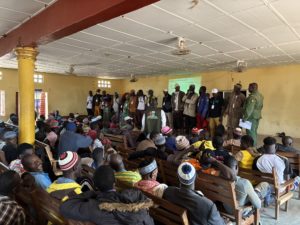
Over the following days, we repeated the same tarpaulin exercise in the 18 villages, visiting two villages per day, with all the field families in the village and in the presence of the two members of the village cooperative committee. The idea was to show the field families the complexity of the Cooperative Committee’s task, and it also allowed everyone to express aloud what they were all thinking: in the end, it will be those who achieve results who will receive the most carbon revenue. Another reassuring lesson is that there are no real differences between the villages: the distribution choices are fairly consistent.
At the very end of the tarpaulin exercise, we asked each village, ‘How much of your carbon income would you be willing to share freely with your village?’ Most participants indicated that they were willing to share about 10% of their carbon income with their community. With this, the villages will be able to develop their infrastructure (wells, market gardens, health posts, schools, etc.).
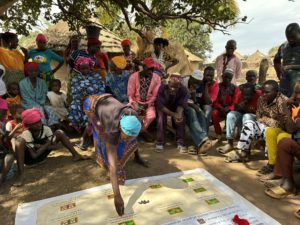
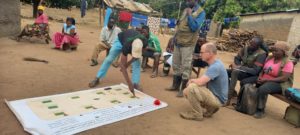
We also discussed opportunity costs with the families involved. By lending their land for reforestation, these farmers are potentially foregoing income from their crops. We therefore worked with them to examine the details of hillside rice cultivation in order to understand all aspects of it (yields, expenses, crop duration, fallow periods, etc.).
In total, 186 people from 18 villages, representing 72% of all the families involved, took part in this deliberation process. For arboRise, participatory reforestation is not just an empty phrase. It is essential that everyone has a say so that they can all take ownership of the project.
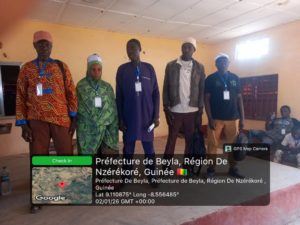
In our experience, one of the drivers of change in any organisation or social group is its leaders. Our process also aims to facilitate the emergence of new leaders, legitimised by transparent elections in their villages and then at sub-prefectural level within the Cooperative. Of course, current political leaders (sub-district chief, mayor of Linko, village chiefs) are involved in the process. They welcome the momentum generated by the project in the region. Indeed, we are convinced that it is the networking of leaders (old and new!) that will be decisive.