
In Samana, we also need to measure the pre-existing biomass (baseline) on a sample, as was done in Damaro in 2025. We should have taken these measurements in 2024, the year the plots were seeded. Measuring these trees two years too late means that their biomass will contain two years of growth and therefore two years of carbon that belongs to the project but that we will have to deduct (since, as we remember, the project cannot account for pre-existing carbon on the land prior to project activities).
Measuring pre-existing biomass requires several steps:
- EcoAct calculates the sample size, performs stratification, and randomly identifies the sample plots and GPS coordinates of the measurement point on each plot.
- We update the standard operating procedure and train GUIDRE
- For each of the 40 plots, GUIDRE’s measurement teams must
- find the plot in the given village
- mark the perimeter of the 600 m² circular plot with barrier tape
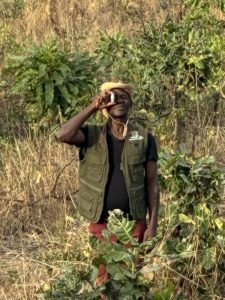
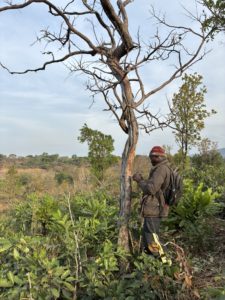
- identify all existing trees, measure their diameter at breast height and height, and identify the species of each tree
- send the data via the Kobo-Collect form
The results show that stratification, based on satellite images, is validated by the reality on the ground. It can also be seen that the number of pre-existing trees per plot is reflected in the NDVI value during the dry season (NDVI measures vegetation health via satellite). NDVI is therefore a relatively robust indicator of pre-existing biomass.
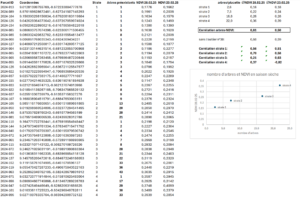
On average, we will need to deduct 30 tonnes of biomass from existing trees from our subsequent measurements.